On August 7, 2025, the U.S. Department of Justice (DOJ) announced a declination under its Corporate Enforcement and Voluntary Self-Disclosure Policy for Liberty Mutual Insurance Company, resolving an investigation into violations of the Foreign Corrupt Practices Act (FCPA). The decision, detailed in a letter published on the DOJ’s website, requires Liberty Mutual to disgorge approximately $4.7 million in profits tied to a bribery scheme involving its Indian subsidiary, Liberty General Insurance (LGI).
Background of the Misconduct
The DOJ’s investigation revealed that, from 2017 to 2022, LGI paid approximately $1.47 million in bribes to officials at six state-owned banks in India to secure or retain business. These payments, disguised as marketing expenses and funneled through third-party intermediaries, facilitated referrals of bank customers to LGI’s insurance products, generating $9.2 million in revenue and $4.7 million in profits. The misconduct implicated certain LGI employees who concealed the payments’ true nature, raising significant FCPA compliance concerns.
Factors Leading to Declination
The DOJ’s decision to decline prosecution was guided by its revised Corporate Enforcement Policy (May 2025) and the Principles of Federal Prosecution of Business Organizations. Key factors included:
Timely Voluntary Disclosure: Liberty Mutual self-reported the misconduct in March 2024, following an internal investigation.
Proactive Cooperation: The company provided all relevant facts, including details about involved individuals, and committed to ongoing cooperation.
Robust Remediation: Liberty Mutual accepted responsibility, conducted a root-cause analysis, terminated involved personnel, and enhanced its global compliance program.
Absence of Aggravating Factors: The DOJ noted no aggravating circumstances, supporting the declination.
Disgorgement and Ongoing Obligations
Liberty Mutual agreed to disgorge just short of $5 million, representing the profits from its relationships with the state-owned banks. The company also committed to continued cooperation with any ongoing DOJ investigations, including making employees available for interviews or testimony. The declination does not shield individuals from prosecution, and the DOJ reserved the right to reopen the matter if new information alters its assessment.
Implications for FCPA Compliance
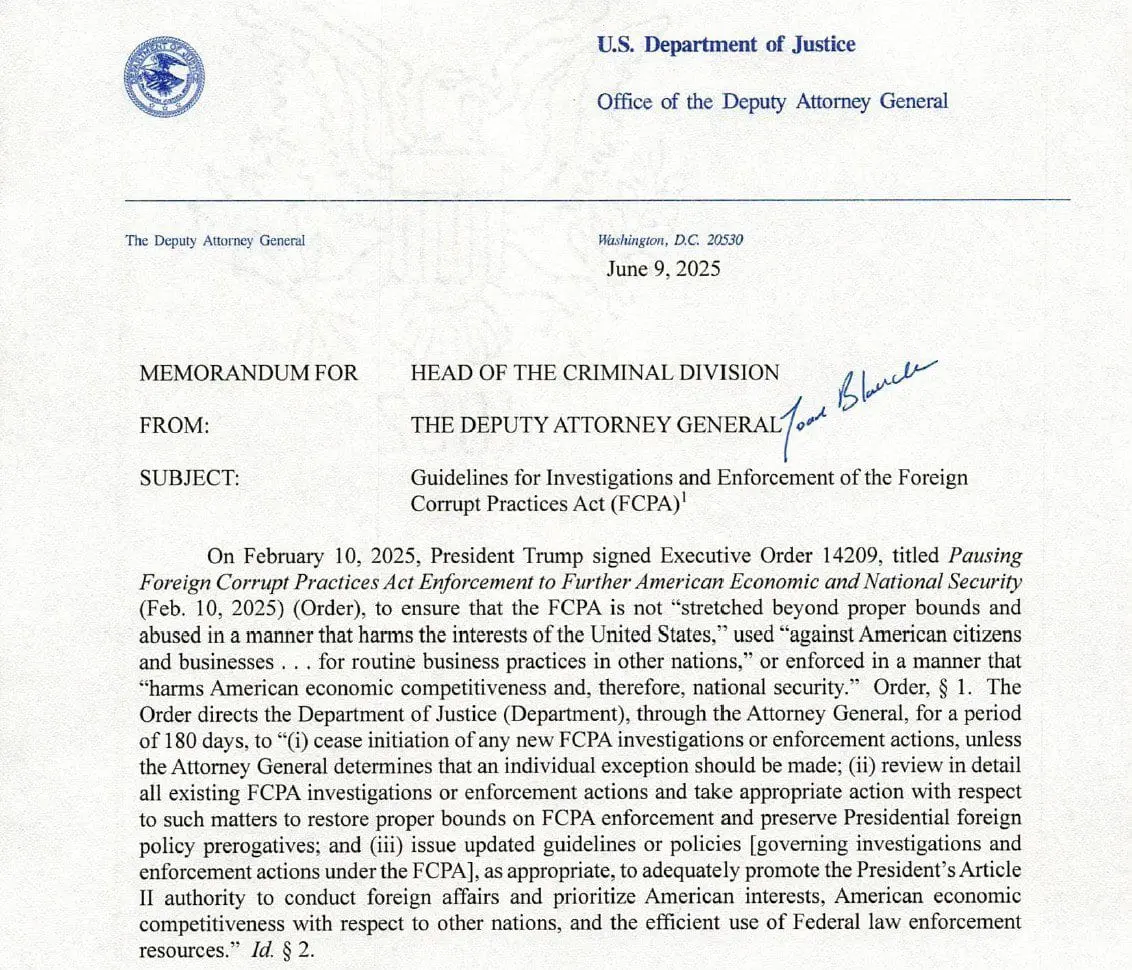
This resolution is notable as it is the first resolution since the DOJ issued revised guidelines on FCPA prosecution. While most companies would view a declination as a ‘win’ when dealing with FCPA liability, as the company had to disgorge almost $5 million, it shows that U.S. companies are not immune from adverse consequences under the FCPA and that the DOJ is willing to pursue cases that do not fall strictly within the categories enumerated in the revised guidelines.