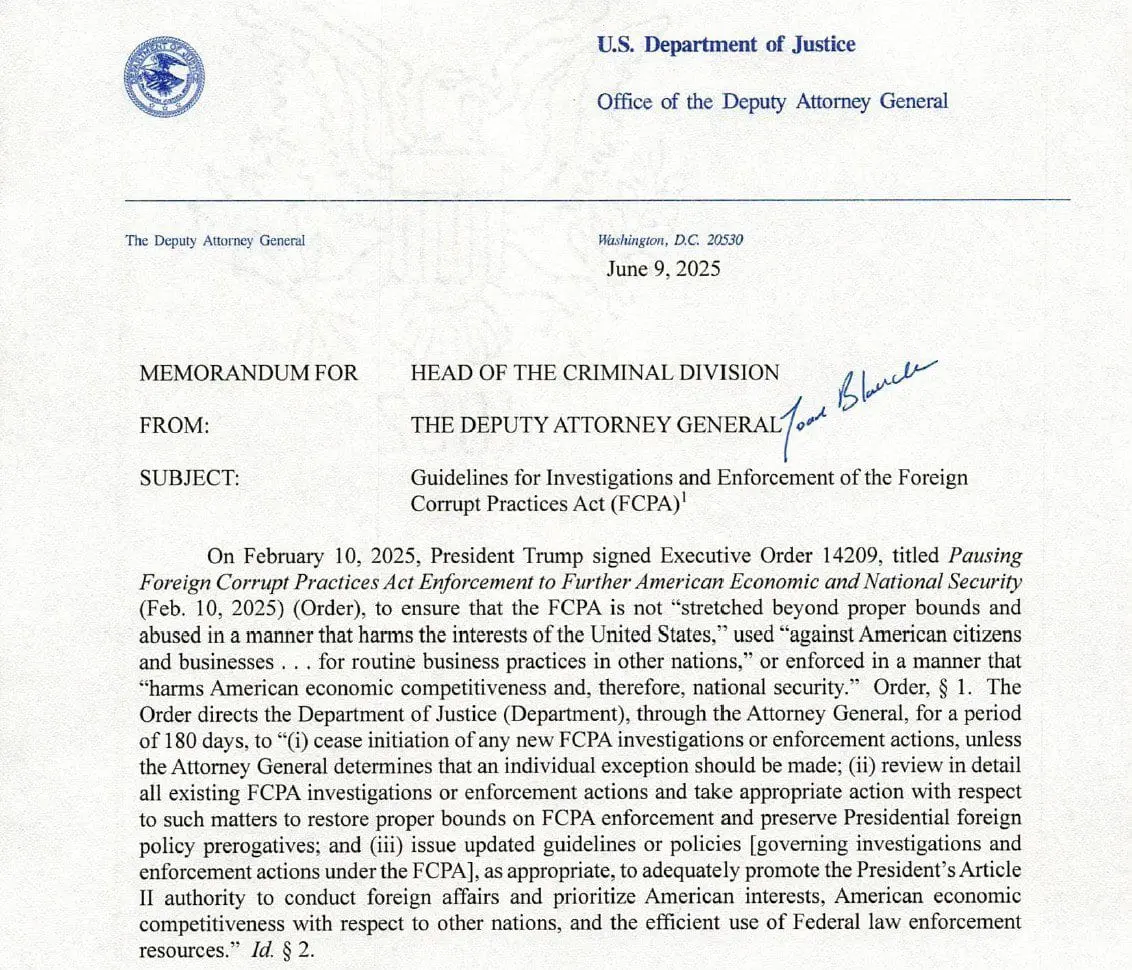
FCPA prosecution is in a period of rapid development. It began on February 5th, when Attorney General Pam Bondi issued a memorandum stating that the Department of Justice (DOJ) would prioritize FCPA cases that relate to drug cartels and transnational criminal organizations. Just days later, on February 10, Trump issued an Executive Order (EO 63) directing the DOJ to “pause” all FCPA cases until new guidelines on FCPA prosecution can be drafted and implemented. The culmination of these developments came on June 9, when Deputy Attorney General Todd Blanche issued a memorandum providing the guidelines (the “Guidelines”) called for in EO 63, setting new standards for FCPA investigation and prosecution for the DOJ.
The Preamble Directions
- Focus on individuals and not vague corporate malfeasance
- Proceed expeditiously in investigations
- Consider collateral consequences
The EO 63 Factors
- Elimination of Cartels and Transnational Criminal Organizations (TCOs)
- Prosecutors should consider whether an investigation will assist in the elimination of Cartels and TCOs. This direction reiterates what AG Bondi stated in her February 5 memo, which is that cases involving TCOs and Cartels will receive priority. Cases involving cartels and TCOs are rare, and it has yet to be seen whether this directive will result in more cases under the FCPA specifically dealing with Cartels and TCOs.
- Safeguarding Opportunities for U.S. Companies
- Prosecutors should consider whether misconduct resulted in economic injury to specific and identifiable U.S. entities. Prosecutors are directed not to focus on the nationality of a company when prosecuting, but identify cases where bribery is harming U.S. companies. Many believed there was a danger that the Guidelines would direct prosecutors to ‘go easy’ on U.S. companies, but the guidelines are clear that the nationality of the company should not be the focus, rather, whether there was harm to U.S. companies is the decisive issue. This is a fair outcome for what was a difficult direction from E0 63 to use the Guidelines to protect American competitiveness. An argument implicit in EO 63 was that U.S. companies sometimes need to pay bribes to level the playing field against foreign companies who use bribes. This may be true in certain cases, but in many industries, U.S. companies competing overseas primarily compete with other U.S. companies. As a result, bribery by U.S. companies in these industries primarily harms other U.S. companies. How the Guidelines have addressed this, by making the focus on U.S. harm, is an astute way of dealing with the issue.
- Advancing National Security Interests
- Prosecutors are directed to focus on prosecution involving urgent threats to U.S. national security, particularly key infrastructure or assets in the defense and intelligence sectors. Cases that fit this criterion would be prioritized under any administration. As a result, this directive is unlikely to have a material effect on FCPA enforcement.
- Prioritize Serious Misconduct
- Prosecutors shall not focus on alleged misconduct involving routine business practices or corporate misconduct that involves de minimis or low-dollar, generally accepted courtesies. The focus of enforcement should be on cases that involve strong indicia of corrupt intent, sophisticated efforts to conceal bribes and efforts to obstruct justice.
Missed Opportunity for FCPA Compensation?
At base, the Guidelines are carefully thought out and bring a balanced approach to the requests made by EO 63. Notably, one issue not addressed in the Guidelines, but mentioned in EO 63, is potential remediation for prior FCPA cases. The implication from EO 63 is that companies fined in past FCPA cases may deserve compensation, but there are more deserving victims of past FCPA violations, namely, U.S. companies who lost out on business because of FCPA violations perpetrated by their competitors.
The concept of a company receiving compensation as a result of a competitor’s misconduct is widely accepted (even outside the U.S.) when it comes to anti-trust misbehavior. When competitors rig or fix a market in violation of anti-trust laws, innocent companies harmed by the misconduct are able to seek compensation. Perhaps this is a missed opportunity in the Guidelines, which could have incorporated the same concept to address when an innocent company is harmed by corruption of a competitor. This issue is particularly apt for the DOJ to address because in most FCPA fines, the DOJ has already done the work of identifying, calculating and confiscating ill-gotten gains through disgorgement.
Take the example of ARR’s FCPA settlement last year. As part of that settlement, ARR disgorged $6 million from a contract it won by illegally winning a tender from Nepal Airlines. That $6 million in disgorgement was swallowed up by the Treasury, but there were at least three U.S. companies that bid and lost out on that tender. These companies, and others similarly situated in other cases, deserve an opportunity to recoup losses, just as they might had ARR been charged with anti-trust violations as opposed to FCPA violations.
Of course, one could argue that harmed companies and individuals always have the right to apply to a court for compensation under existing laws, such as the Mandatory Victims Restitution Act and Crime Victims’ Rights Act, but incorporating the concept into the Guidelines would have been a tidier way to address an issue raised by EO 63.