(This article originally appeared on Law360)
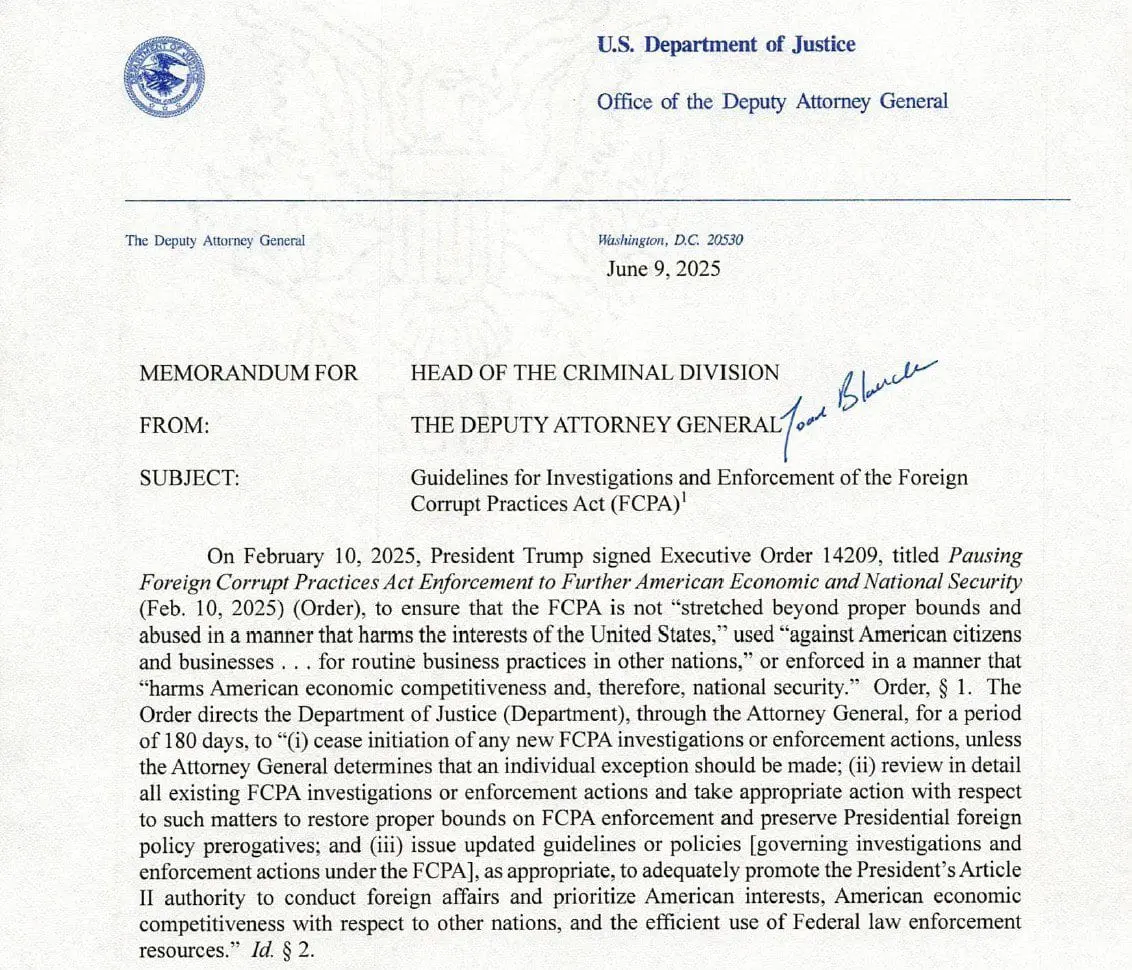
While many people have debated the accuracy of the Corruption Perceptions Index (CPI), the latest 2023 report has shown a decline in CPI scores in many European countries.[1] While some may see this as evidence that bribery in Europe is being effectively combatted, Europe is still in desperate need of a coordinated strategy against bribery and corruption. The Foreign Corrupt Practice Act (FCPA) is not a perfect an anti-corruption law, but it is undisputable that the FCPA has gotten results for the U.S. Since its enactment in 1977, the FCPA has resulted in over 700 enforcement actions spanning more than 100 countries. [2] While many view this as a positive thing, government officials outside the U.S., particularly those in the EU, have been critical of what they view as jurisdictional overreach. This criticism is unfounded and likely based on a misunderstanding of why foreign companies find themselves being fined under the FCPA.
Foreign Enforcement of the FCPA
European critics of the FCPA have often decried the extraterritorial application of the FCPA,[3] focusing on its impact on European companies. Critics in Europe argue that the extension of U.S. legal authority has gone beyond traditional limits with the FCPA, and express concerns about the potential erosion of EU sovereignty through the use of FCPA as a political and economic lever.
This view finds support in Eurozone publications such as the ‘EU Reporter,’ [4] which point out the scrutiny and financial penalties faced by European companies who have been found to have violated the FCPA. The overarching theme of this criticism is that the FCPA is an overreach of jurisdiction when it is used to fine companies based in the EU. However, this thesis is flawed as it overlooks the most basic and important fact regarding jurisdiction under the FCPA for foreign companies: jurisdiction is optional and voluntary.
The FCPA’s Application to EU Companies
The FCPA’s jurisdictional reach is limited when it comes to companies based outside the U.S. For EU-based companies, there are essentially only two ways in which they can become subject to the FCPA’s provisions:
- Someone from the company violates the FCPA while in the territory of the United States. Given that almost every country in the world applies their criminal laws to actions within its territory, there can be little argument that this approach is unjust. To be fair, even EU-based critics would be unlikely to take issue with this application of the FCPA.
- The second way a foreign company can become subject to the FCPA is if the company chooses to list their stock on a U.S. securities exchange, such as the New York Stock Exchange (NYSE) or the NASDAQ. This is not a unilateral decision and shares must be registered with the Securities and Exchange Commission (SEC) and listing requirements must be met before the company can list. Once listed on the NYSE or NASDAQ, the company then becomes subject to all U.S. securities laws, including the FCPA. This has been the jurisdictional basis for almost every European-based company that has been fined under the FCPA. This may be the point that critics in the EU either misunderstand or take issue with.
The Listing Securities In the U.S. is a Fair Application of Jurisdiction
Using the listing of securities in the U.S. as a basis for jurisdiction is the fairest application of jurisdiction that any company could ask for. Here’s why:
- Listing securities in the U.S. is voluntary. EU companies are not forced to list in the U.S. They do not have to list their stock anywhere, and even if they do want to list, they can choose to list on any number of exchanges in their home country, in Europe or around the world (outside the U.S.)
- Listing securities in the U.S. is an informed decision. It is implausible that any EU company could list in the U.S. without the assistance of highly specialized lawyers and accountants. Not only will these professionals provide specific advice to the company on the implications of listing (such as becoming subject to the FCPA) but these warnings will also be communicated to the owners of the company so that an informed decision on whether to list in the U.S. is made.
- Listing securities in the U.S. is a decision that involves consent from the board and from shareholders. Listing securities in the U.S. is a huge undertaking, and not one that can be taken without significant changes to the company’s formation and ownership structure. As a result, it is almost guaranteed that any EU company that wants to list in the U.S. will need the approval of their board and their shareholders. This means that not only does the company consent to the application of U.S. securities laws (such as the FCPA), but the shareholders of the company also agree.
- Listing in the U.S. is highly lucrative. The reason that EU companies want to list in the U.S. and undertake the burdens of U.S. laws such as the FCPA, is because listing provides huge financial benefits for the company. For example, being listed in the U.S. allows the company access to the world’s largest market for capital, and usually allows the company to raise funds by issuing additional shares through secondary offerings. Also, the U.S. is known for its high liquidity and trading volumes, which provide shareholders with the ability to buy or sell shares more easily. At a minimum, EU companies that list in the U.S. have significantly better access to capital, which impacts their share price positively, which is likely why companies make the decision to list in the U.S.
- The application of the FCPA is universal to all companies listed in the U.S., regardless of where they are located, and this is for good reason. When an EU company joins the NYSE or NASDAQ, it competes against U.S. companies for capital. U.S. investors, pension funds or index funds may now choose to invest in the EU company instead of a U.S. company. As the EU company is competing with U.S. companies for capital on the exchange, it is critical for fair competition that both companies are subject to a common set of laws. To hold otherwise would allow EU companies to enjoy all the benefits of being listed on the NYSE or NASDAQ, while avoiding any of the regulations that were put in place to ensure fair competition between companies on the exchange. In essence, the critical posture toward the FCPA that some advance would seem to result in an outcome where EU companies are allowed to improve their financial position through bribery, and then compete for capital in the U.S., against U.S. companies who are not allowed to do the same. This would be an absurd result.
Ultimately, any EU company that decides the burden of the FCPA is too much can delist its stock from the U.S. However, even EU companies that have faced billion-dollar fines for violating the FCPA, have not opted to do this, likely because the financial benefits of being listed in the U.S. far outweigh the penalties they have faced or are likely to face.
In sum, EU companies who are fined by the SEC and DOJ chose to submit to the FCPA. They do so willingly, having been advised by counsel, and with the full approval of their board and their shareholders. There is no better or fairer basis for jurisdiction than a choice made freely by the company and its stakeholders. Listing in the U.S. comes with great financial advantages, and in order to compete for capital with U.S. companies, EU companies must follow the same rules.
Many commentators point out that when looking at the largest FCPA fines, the majority are against companies based outside the U.S. This is not evidence of unfair treatment, but an likely result of the fact that the FCPA is the Foreign Corrupt Practices Act. In other words, the anti-bribery provisions of the FCPA only penalize corruption of foreign officials, i.e., those based outside the United States. As a result, it is not surprising, and in fact should be expected, that the primary offenders of the FCPA would be companies that operate primarily outside the U.S.
The idea that the U.S. uses the FCPA to ‘make money’ is also misguided. Through joint enforcement actions with local prosecutors, the U.S. is increasingly helping law enforcement in developing economies levy fines against companies who have engaged in corrupt activity. In addition, when U.S. enforcement agencies fine a company in a joint enforcement action with a local prosecutor, the U.S. gives the company a credit for any fines it has paid to local prosecutors for the same conduct. This is not the conduct of an enforcement regime that seeks to ‘make money’, but the hallmark of a fair and equitable application of the law.
Business Ethics
Finally, there is also a business ethics issue that ought to be addressed. As stated by the DOJ: “foreign bribery is a scourge that must be eradicated. It undermines the rule of law, empowers authoritarian rulers, distorts free and fair markets, disadvantages honest and ethical companies, and threatens national security and sustainable development.”[5] The FCPA is one of the only laws in the world that has been able to curtail major corruption by multinational businesses. The world needs more accountability for corrupt political leaders, not less.
European countries have been abysmal in their enforcement of anti-bribery laws. Even though the European Commission has raised proposals to harmonize and strengthen anti-corruption rules and penalties across the EU,[6] this process will take years before adoption and likely decades before enforcement.
Criticism of the FCPA appears to misunderstand basic legal concepts. The FCPA does not confer exclusive global regulatory power to the U.S. to police bribery, it allows the U.S. to ensure that companies competing for capital and trading stock in the U.S. follow the same rules as U.S. companies in that market. The impact on European companies of FCPA fines is a result of their voluntary decision to accept the benefits and regulations associated with listing in the U.S.
The FCPA plays a vital role in combating bribery and corruption, particularly in regions lacking robust regulatory frameworks and critics should take aim not at the FCPA, but rather at the lack of equivalent laws being enforced by EU countries.
Footnotes
[1] https://www.transparency.org/en/cpi/2023
[2] https://fcpa.stanford.edu/statistics-analytics.html
[3] https://www.brusselsreport.eu/2021/12/16/how-u-s-extraterritorial-legal-action-affects-european-companies/
[4] https://www.eureporter.co/world/2022/07/28/how-the-usa-turned-the-fight-against-corruption-into-a-goldmine/
[5] https://www.justice.gov/criminal-fraud/file/1292051/download
[6] https://home-affairs.ec.europa.eu/policies/internal-security/corruption/eu-legislation-anti-corruption_en